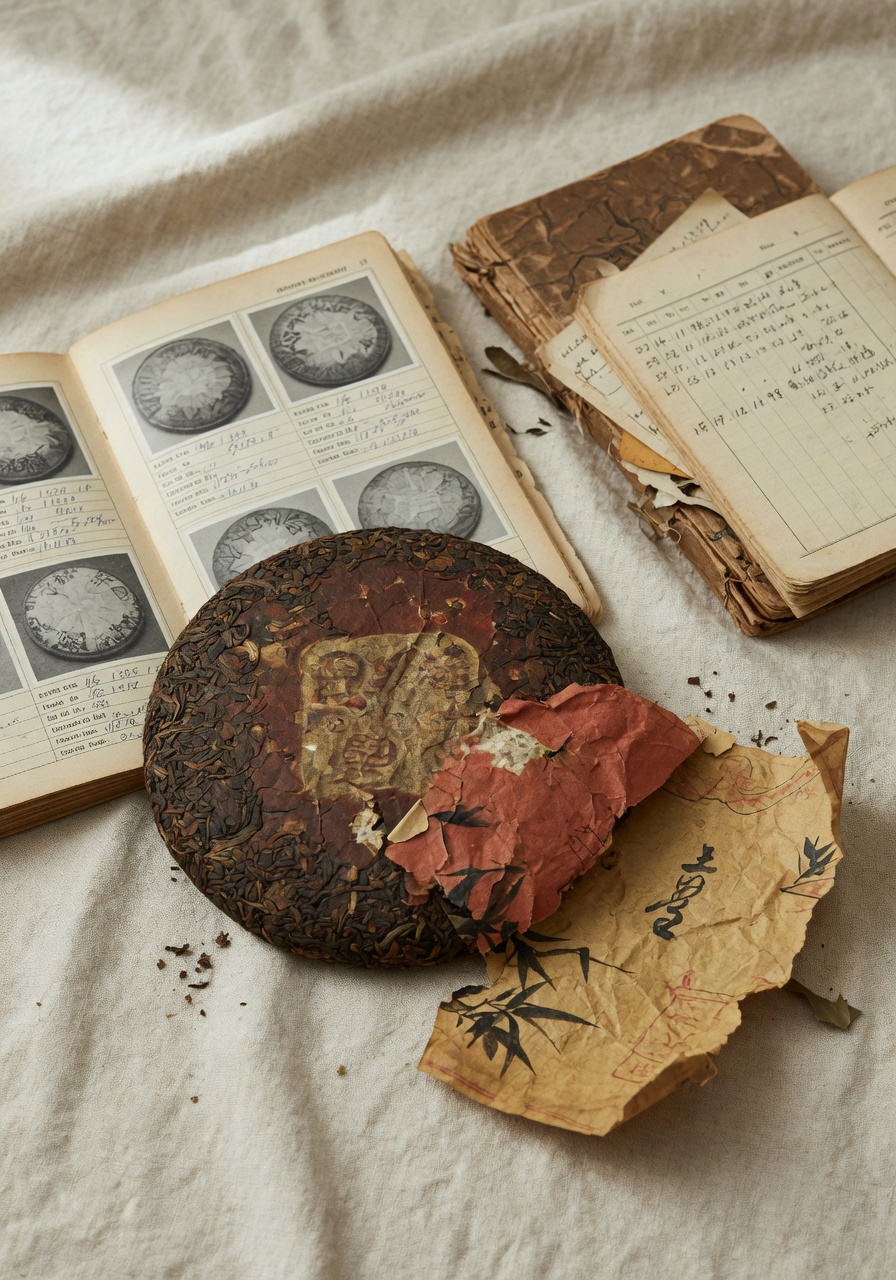
What the 2024 ledger holds
The 2024 vintage tracker is a year’s worth of auction-room arithmetic gathered into one report. We sit in the back of the sales — Hong Kong in spring, Guangzhou in summer, Taipei in autumn, and the two European houses that began listing aged Chinese cakes in earnest around 2018 — and we write down what was actually paid. Hammer price, buyer’s premium, lot description, wrapper photographed on a plain table under a window. Nothing else.
The report runs to roughly ninety pages each March. Most of it is tables. A short essay opens each chapter, written by the cataloguer who attended that particular sale, because a tong of 1990s Qī Zǐ Bǐng Chá (七子饼茶) does not trade in a vacuum — it trades after someone in the room has lifted the wrapper, smelled the Wò Duī (渥堆) on the older shou cakes, and decided whether the storage matches the story. We try to record that context without selling it.
The programme exists because our community asked for it. For years, members at tea.community kept compiling private spreadsheets of auction results, comparing notes on whether a 2003 Yiwu was priced fairly against a 2005 Banzhang. The information was out there — auction houses publish results — but it was scattered across four languages, three currencies, and a dozen catalogues. The 2024 tracker pulls those threads into one place. It does not predict. It records.
A few words on what the report is not. It is not a market-making document. It is not an offer to buy or sell anything. It does not assign forward valuations to cakes in your own storage. If you are looking for a buy recommendation on a specific 7542 batch, this is the wrong document — try the conversations at puerh.app instead, where collectors discuss provenance and condition in detail. The tracker simply tells you what other people paid in 2024, in public, with full lot documentation. What you do with that information is your business.
The methodology section, which runs to about twelve pages, is where serious readers spend their time. We disclose every sale we attended, every sale we excluded, and why. Private treaty sales are excluded — only open auction with published results makes the ledger. Lots withdrawn before sale are noted but not priced. Currencies are converted at the spot rate on the hammer date, with a footnote showing the original sum. Where a lot’s authenticity was contested in the room, we record the dispute rather than suppress it.
The report is released each March, once the final 2024 European sales have settled and the Lunar New Year auctions in Hong Kong have closed their books. Subscribers receive a hardcover copy posted from Yunnan and a searchable PDF. The hardcover is set in a plain serif on uncoated paper, sewn in signatures — it is meant to sit on a shelf next to the cakes it describes, and to be readable in ten years when the 2024 vintage itself has aged into something different. Equipment for proper storage and weighing of those cakes is documented separately at tea.equipment, which we reference where relevant.
This is record-keeping, not advice. We think the distinction matters.
What changes
-
Every auction lot is photographed against the same neutral background — wrapper, neifei, and cake face, so condition is readable years later.
-
Currency conversions show both the original hammer sum and the spot-rate equivalent, with the conversion date footnoted on each line.
-
The methodology chapter lists every sale attended and every sale excluded, with the reason for exclusion stated plainly.
-
Contested lots — disputed authenticity, withdrawn provenance, post-sale corrections — are kept in the record rather than quietly removed.
-
Subscribers receive a sewn hardcover posted from Yunnan plus a searchable PDF; both carry the same page numbering for citation.
-
A short essay opens each auction chapter, written by the cataloguer who attended the sale in person.