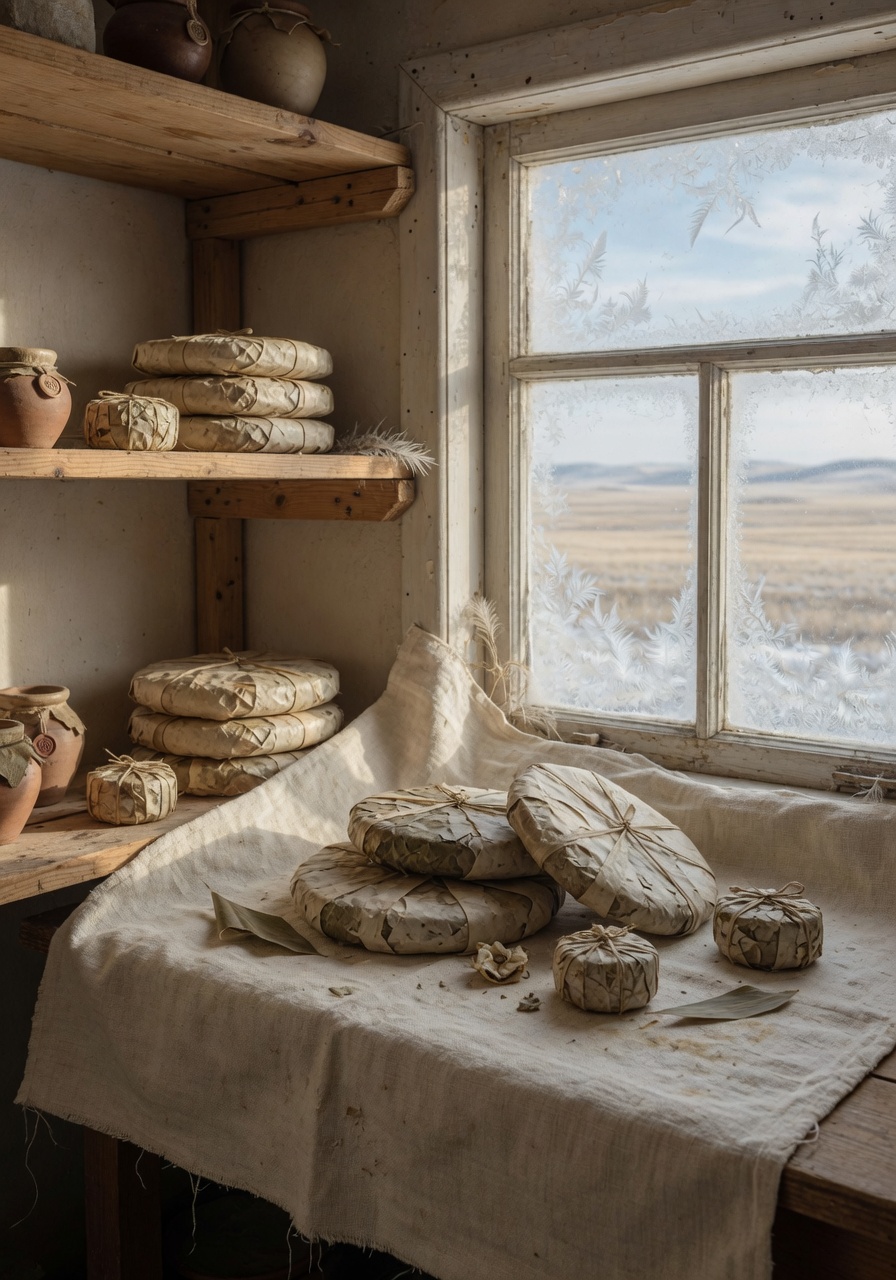
A working aging cellar on the steppe edge of Ulan-Ude, where sub-zero winters and dry summers shape pu-erh on a slower curve than anywhere in Yunnan or Guangdong.
A cellar on the third climate
The Buryatia continental cellar sits on the southern edge of Ulan-Ude, a low wooden building set back from the road behind a screen of larch. From outside it reads as a workshop — single storey, dark stained boards, a metal stovepipe rising through a steep roof pitched against snow load. There are no signs. The only marker is a small enamel plaque by the door, hand-painted with the cellar number and the year the first cakes went in: 2018.
Inside, the air is dry and cold for nine months of the year. This is the point. Where the Yunnan storage rooms breathe wet monsoon air and the Guangdong rooms hover near tropical equilibrium, this cellar tracks a continental curve — minus thirty in January, plus thirty in July, single-digit humidity in winter. Pu-erh ages here on a different clock. Slower in the cold months, then a short concentrated push in summer when the boards warm and the cakes give off the faint hay-and-camphor note that Amgalan Chin has been documenting season by season since the cellar opened.
Amgalan is the resident master and the reason the cellar exists in this form. His work along the old Russian–Mongolian tea routes — covered in long form on puerh.app and in the field notes archive at thetea.app — gave him a clear thesis: that the Siberian climate, far from being hostile to pu-erh, simply produces a third archive against which Yunnan and Guangdong storage can be measured. The cellar is the experiment. Each cake that enters is logged, weighed, photographed, and shelved by lot. Twice a year Amgalan opens a control cake from each batch, brews it side by side with sister cakes held in Kunming and Foshan, and the tasting notes go into the shared dataset.
This is not a guest house. There are no bedrooms, no sleeping arrangements, no in-residence meals. What there is, for clients with cakes in storage or with serious interest in continental aging, is access — booked by the half-day, guided by Amgalan, conducted in a small tasting room partitioned off from the cellar floor by a heavy felt curtain.
The tasting room is plain. A long table of unfinished pine, a cast-iron stove that holds the room at around eighteen degrees in winter, two windows facing south. On clear days the light comes in low and flat across the table, catching the rim of the gaiwan. Cakes for the session are brought through from the cellar still cold; part of the work is watching how a wrapper softens as the paper warms, how the compression eases, how the first rinse runs different colours depending on whether the cake has wintered here for one year or seven.
The surrounding land matters to the programme. Ulan-Ude sits in the Selenga river basin, an hour from Lake Baikal, and the steppe wind that comes off the grasslands in autumn is part of what dries the cellar down before the deep cold sets in. Amgalan walks the perimeter most mornings before opening the doors — a habit he describes as listening for the building. If the wood is creaking heavily or the door seal has shifted, the readings get checked twice. The cellar runs on hygrometers and notebooks, not climate control. That austerity is deliberate.
Clients come for one of three reasons. The first is to deposit cakes — Shēng Pǔ’ěr (生普洱) primarily, occasional Shòu Pǔ’ěr (熟普洱), bought through shop.puerh.app or brought in privately, logged into the cellar’s tracking system and stored on long-term contracts. The second is to taste their own cakes against the control set, usually once a year, often in August when the cellar is at its warmest and the teas show most. The third is research — students from tea.school and writers from tea.community who want to see what a continental archive looks like in practice. All three are welcome. None of them stay overnight in the cellar itself; lodging is arranged separately in town.
What gets poured, and how
The cellar is, first, a working storage facility. The tasting programme exists in service of that — to let depositors and visitors understand what continental aging does to the cake on their shelf.
Sessions are run by Amgalan, in Russian or English, usually three to four hours. Every session begins the same way: a walk through the cellar floor, lot by lot, with the current month’s hygrometer readings laid out on a clipboard. Cakes are not handled by guests. They are observed in place, on the larch shelving, wrappers facing out so the lot numbers and nèi fēi (内飞) are visible. Amgalan reads the room aloud — which batch is settling, which one ran hot in the summer push, which wrapper has darkened on the south wall.
The tasting itself focuses on comparison. A typical sitting might run a 2019 Bùlǎng (布朗) sheng pressed in Menghai, with three cakes from the same lot drawn from three storage climates: one held in Kunming, one in Foshan, one in this cellar. The Buryatia cake will almost always show brighter, with the green pine and stone-fruit edges still present, where the Foshan sister has gone darker and rounder. The point is not to declare one better. The point is to read the climate off the cup.
Yīwǔ (易武) sheng features heavily — Amgalan’s long-standing interest — alongside selected Shòu Pǔ’ěr (熟普洱) batches where the Wò Duī (渥堆) finish is now twelve to fifteen years behind them and the cellar is doing the slow back-end work. Occasional Hunan dark teas come into the rotation when Zhou Xiang sends sample bricks north for cross-reference.
Water is local, filtered hard well water from the Selenga basin, used deliberately because it is the water the cellar itself breathes. Brewing is done in plain white porcelain gaiwan — nothing demonstrative, nothing that would colour the read. Notes are taken by hand, in a shared logbook that visitors are welcome to read but not to photograph. The full annual readings are published in summary form on puerh.app each February and feed into the cross-storage reference set at thetea.app.
Storage contracts start at €240 per cake per year and include twice-yearly condition reports, one annual tasting slot, and entry into the comparison dataset. Cakes purchased through shop.thetea.app or shop.puerh.app can be shipped directly to the cellar for deposit.
Amenities
-
climate-logged aging cellar with twice-daily hygrometer readings
-
larch shelving, lot-numbered, south and north wall positions tracked separately
-
tasting room with cast-iron stove, pine table, south-facing windows
-
filtered Selenga-basin well water for all brewing
-
porcelain gaiwan and fairness cups, no clay (to keep tastings neutral)
-
shared cellar logbook, on-site reference set from Kunming and Foshan
-
annual condition reports per deposited cake
-
secure entry, single-access door, no public hours
What’s included
-
one half-day tasting session with Amgalan Chin per storage year
-
twice-yearly written condition report per deposited cake
-
entry into the cross-storage comparison dataset published on puerh.app
-
intake logging — weight, wrapper photograph, lot record
-
side-by-side tasting against Kunming and Foshan control cakes on request
-
transfer-out service for cakes returning to owners (packing, customs paperwork)