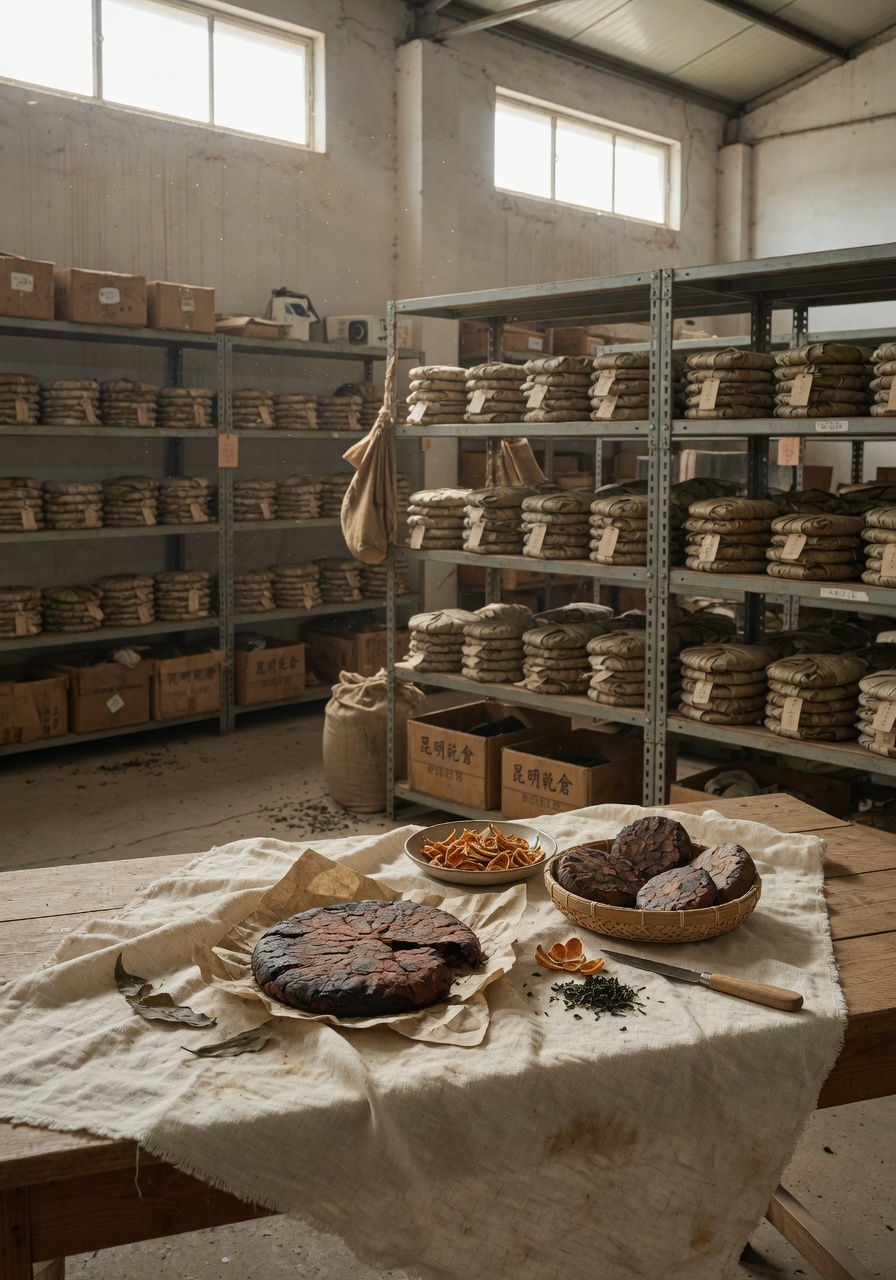
A Kunming dry-storage partner for the classical aging climate — cakes deposited on-site, photographed quarterly, with sealed conditions logged across the slow turn of each year.
A warehouse at altitude, not a holiday
This is not a property you sleep in. It is a partnership — a quiet, climate-stable room on the edge of Kunming where cakes of shēng pǔ’ěr (生普洱) are laid down, catalogued, and left to do the work that only time can do. The building sits at roughly 1,890 metres on the Yunnan plateau, in a converted trade depot near the old Kunming–Hekou rail line. Brick walls, north-facing windows shuttered most of the year, a concrete floor warmed only by the season. Outside, the city hums; inside, the air carries the dry sweetness of camphor wood and pressed leaf.
Kunming storage is the reference climate for classical aging. Mean annual temperature hovers around 15°C, relative humidity sits in the 55–68% band — cool enough to slow microbial activity, dry enough to keep the cake structure intact, with just enough seasonal variation to encourage the gradual oxidation that defines the canonical Kunming profile. Cakes aged here do not develop the deep, damp wardrobe notes of Guangzhou storage. They sharpen instead — orchid, dried apricot, a high clean bitterness that resolves into camphor over fifteen to twenty years. This is the storage that Hong Kong traders pivoted toward in the 1990s when they wanted predictability. It is what Amgalan Chin — our resident specialist and the partnership’s technical lead — calls the patient climate.
Amgalan spends roughly one week each month on site. His background is the Russian–Mongolian caravan trade — generations of family handling pressed tea across cold, dry distances — and that lineage shows in how he treats the warehouse. He keeps a logbook, paper, not digital first. Temperature and humidity are recorded twice daily at four positions in the room. Cakes are rotated on a quarterly cycle: shelves nearest the wall move outward, those near the centre move inward, so that no cake spends consecutive years in the same micro-zone. Each cake is photographed on deposit, then again at every quarterly rotation — front, back, and a close detail of the wrapper script. Photographs are uploaded to your portfolio, with a written note on visible change. Amgalan also publishes long-form aging notes on puerh.app, where members of this partnership receive early access to his climate comparisons.
The room itself is plain. Wooden shelving in Yunnan pine, sized to the standard 357g bǐng (饼) and to the larger zhuān (砖) bricks for clients who prefer them. Sealed bamboo zòng (筒) containers of seven cakes each, stacked along the inner wall — these are inspected annually and re-wrapped if the bamboo shows wear. A small workbench by the window holds the scales, a calibrated hygrometer, and a 1990s thermos that Amgalan refills with hot water every morning out of habit. There is no tea room here in the hospitality sense. There is a single low table near the door, two stools, a gàiwǎn (盖碗), and a kettle — used only when a depositor visits and asks to taste from their own holdings.
The surrounding district is unremarkable in the best way. A noodle shop two doors down, a small wholesale tea market five minutes’ walk, the train tracks behind. Kunming itself is a city that rewards slowness — the spring city, as locals call it, where the weather barely shifts and the trees stay green through January. If you do visit, we can arrange a tasting day with Amgalan and connect you with sourcing partners through tea.travel, who run small group trips out to Bulang and Yiwu in the spring picking season. Most depositors never come. They send cakes, receive photographs, and let the years pass. That is the proposition: a building you trust, a person you trust, and a climate that has been doing this work, quietly, for a very long time.
How cakes are received, logged, and aged
Deposits work on an annual cycle. Cakes can be sent directly from producers we work with in Yiwu, Bulang, Menghai, and Jingmai — sourcing is coordinated through shop.puerh.app, where the partnership maintains a curated list of pressings each spring — or you can ship your own holdings to the warehouse from any origin, subject to a brief intake inspection.
On arrival, every cake is weighed, photographed under standardised light, and assigned a deposit code that follows it through its life in storage. Wrappers are inspected for damage in transit; any small tears are noted but not repaired, since the original wrapper is part of the cake’s provenance. Cakes are then placed on the shelf position recommended by Amgalan based on age, pressing density, and intended holding period. Newer pressings, which respire more actively in their first three years, are placed nearer the outer wall where seasonal variation is slightly more pronounced. Older, more stable cakes move toward the centre.
The core deliverable each quarter is the photograph set and a short written note — two or three sentences from Amgalan describing visible compression change, wrapper oxidation, and any aromatic shift detectable at the shelf. Once a year, in October, depositors receive a full annual review: climate logs for the twelve months, a comparison photograph against the deposit baseline, and an updated reference valuation drawn from secondary market activity. The valuation is informational only — it is not a guarantee, and the disclosure page sets out the risks in detail.
Tastings are available by appointment. If you visit Kunming, Amgalan will brew a sample drawn from one of your own cakes — never from another depositor’s holdings — using a small portion broken from the back of the cake and noted in the logbook. He uses a porcelain gàiwǎn, mineral water from a single Yunnan source he has trusted for years, and short infusions in the gōngfū (工夫) style. Sessions usually run two hours, sometimes longer if a comparative tasting against younger or older holdings is requested.
Depositors who also hold tea at our Yiwu or Mengla partner sites can request side-by-side comparison reports, useful for understanding how the same pressing ages in different climates. These cross-site comparisons are published in summary form to tea.community, with depositor identities kept private.
Amenities
-
Climate-monitored storage at 15°C mean, 55–68% RH
-
Yunnan pine shelving with quarterly cake rotation
-
Sealed bamboo zòng containers for seven-cake units
-
Calibrated twice-daily climate logging in paper and digital form
-
Single tasting table with porcelain gàiwǎn and kettle for depositor visits
-
On-site inspection bench with scales and calibrated hygrometer
-
Located near Kunming wholesale tea market for sourcing visits
-
Twenty-minute drive from Kunming Changshui airport
What’s included
-
Quarterly photograph set and written note per cake
-
Annual climate log and comparison photograph against deposit baseline
-
Annual reference valuation drawn from secondary market activity
-
Wrapper inspection and bamboo re-wrapping as needed
-
Tasting session with Amgalan Chin by appointment, drawn from your own holdings
-
Portfolio dashboard access with cross-site comparison where applicable
-
Insurance against fire, flood, and warehouse-side handling loss