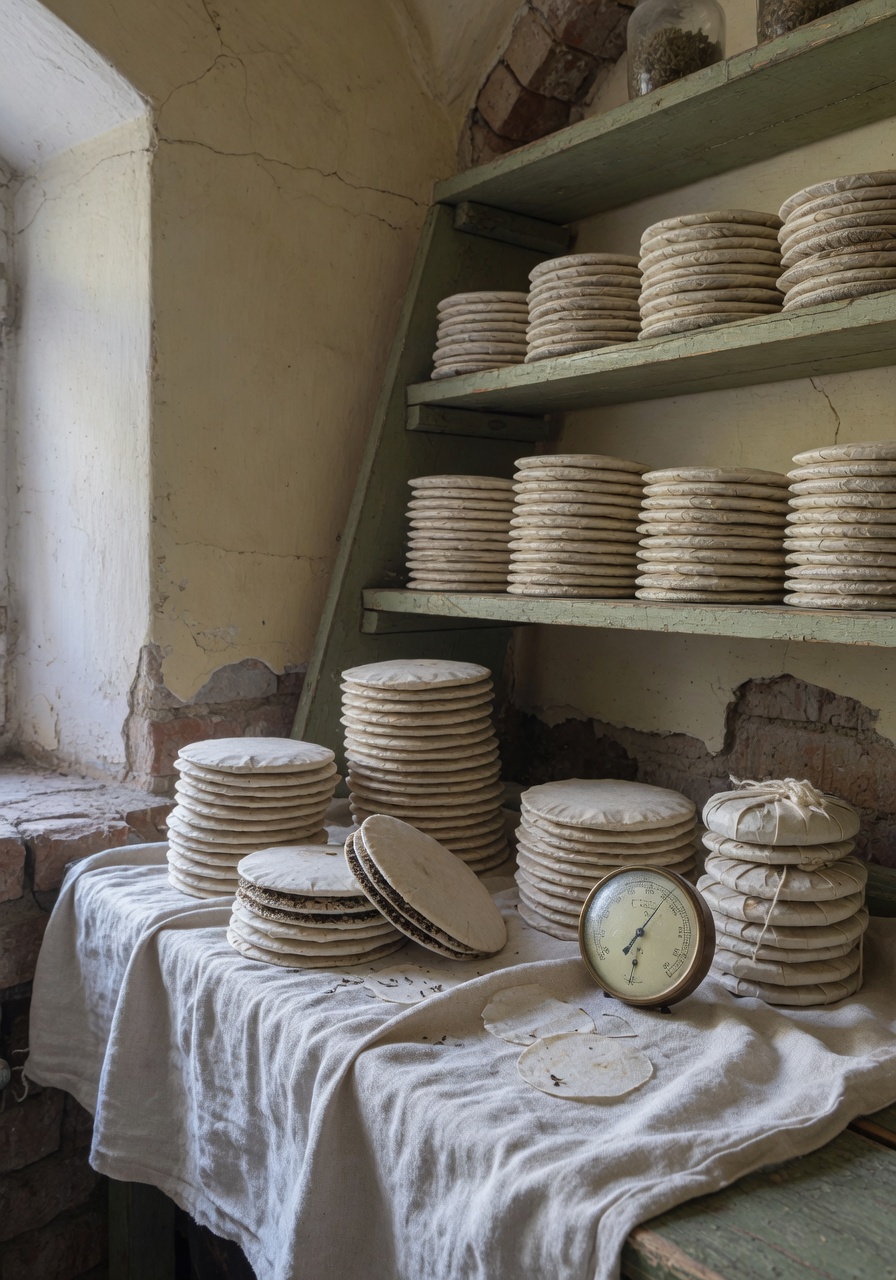
A climate-held cellar on the northern bank of the Neva, where named cake parcels rest under audit, insurance and the quiet attention of a resident master who has tracked these leaves across borders for two decades.
A cellar on the northern bank
The vault occupies the lower two floors of a stone merchant house built in 1847, set back one courtyard from the embankment. From the street you would not find it — there is a brass plate, the size of a playing card, with no name on it, only a number. Past the inner door the air changes: cooler by four degrees, drier than the city outside, and carrying the long compound smell of aged leaf — camphor, damp cedar, something between honey and forest floor — that members recognise the moment they cross the threshold.
This is not a hotel and not a teahouse. It is a bonded storage partnership for members of the constellation who hold cakes of shēng pǔ’ěr (生普洱) and shóu pǔ’ěr (熟普洱) and wish to age them under conditions colder, steadier and more accountable than a private apartment can offer. Each parcel arrives in its original wrapper, is photographed front and back, weighed to the gram, logged to a public ledger and shelved on cedar racks under the member’s name. The wrappers face outward. Walking the central aisle, you read a quiet inventory of provenance — Bulang, Yiwu, Jingmai, Mengku — handwritten in Chinese characters, stamped in red, some faded by the years they have already travelled.
The building’s thick masonry does much of the work. Saint Petersburg’s climate, for all its reputation, gives a cellar what a cellar wants: cool summers, low diurnal swing, winters tempered by the river. Amgalan Chin, the resident master, has spent four years calibrating the rest. Hygrometers in every bay feed a single dashboard; a humidification line, fed by filtered Ladoga water, holds the main hall at 62–66 % through the dry months. There is no perfume, no incense, no varnish — nothing that the leaf might learn by accident. Members are asked to wash their hands at the stone basin by the door before touching anything wrapped in their name.
Amgalan keeps an unhurried daily rhythm. He arrives before nine, walks the aisles with a notebook, opens the eastern shutters for forty minutes when the outside dew point allows it, and brews a single pot at the long elm table in the antechamber to check what the cellar is doing to a reference cake from each cohort. Members are welcome to sit with him during this morning tasting if they have written ahead. The cups are small, the conversation slower than the tea. He has been working the Russian–Mongolian trade routes since the late 1990s and writes, in two languages, on puerh.app about what a northern cellar does to Bulang leaf over a decade. His longer notes on dark tea cohorts and Wò Duī (渥堆) practice appear on thetea.app for members of the wider constellation.
The surrounding district is a quiet one. The embankment is a five-minute walk; the Mariinsky a tram ride south; the New Holland gardens close enough to take an afternoon walk between sessions. The cellar itself has no overnight rooms — members in town for an audit stay in apartments nearby, which the office is glad to arrange. The point of being here is not to live in the building. The point is that your cake is, and that you can come stand in front of it, lift it from its shelf, smell the paper, replace it, and walk back into the city knowing exactly where it rests and under whose eye.
Once a year, in late October, the vault is audited by an outside firm and the full ledger published. Members may attend the count. Afterwards there is tea in the antechamber — usually a cake from the cellar’s own reference shelf, broken into the gaiwan by Amgalan himself, the wrapper folded back to show the date.
What the cellar pours
The vault is, first, a storage partnership rather than a tasting room — but a partnership of this kind only works if members can taste, regularly and against a baseline, what their own cohort is becoming. So the programme is built around reference brewing rather than performance.
Each member parcel is shadowed by a small reference quantity from the same pressing, shelved separately and brewed quarterly. Amgalan keeps tasting notes in a bound ledger: water temperature, leaf-to-water ratio, infusion times, observations on liquor colour, aroma, mouthfeel and aftertaste. The notes are dry and specific — no adjectives that would not survive translation. Members receive the notes for their own cohorts by post or through their account on shop.thetea.app, where the reference cakes themselves can be acquired by other members of the constellation who want to follow a particular pressing without committing to long-term storage.
When members visit, sessions happen at the long elm table in the antechamber. The water is filtered Ladoga, brought just off the boil for shēng and to full rolling for older shóu. Vessels are plain — a thick-walled white porcelain gaiwan for reference work, a small Yixing pot reserved for one named Bulang cohort that has been with the cellar since 2019. Pours are short, cups small, and the first three steepings are taken in near silence so that the leaf is heard before it is discussed.
The range under reference is narrow on purpose. Sheng from Bulang, Yiwu, Jingmai and Mengku; shou from a handful of Menghai and Lincang pressings; one shelf of Liu Bao and one of aged Liu An, kept for comparison with the puerh cohorts. Nothing flavoured, nothing scented, nothing outside the dark and post-fermented families. Members curious about Bái Háo Yín Zhēn (白毫银针) or Mí Lán Xiāng (蜜兰香) are referred, with warmth, to the white-tea programme at tea.travel’s Guangdong residencies and to the courses on tea.school that cover those families properly.
Audit week in late October is the one moment the cellar opens more widely. Members may bring one guest to the closing tea, and Amgalan brews three cakes from the reference shelf — usually a young sheng, a mid-aged sheng around twelve years, and an older shou — so that newcomers can taste, in one sitting, what a decade in this particular cellar does to leaf they might be considering.
Amenities
-
Climate-held storage at 16–18 °C, 62–66 % relative humidity, monitored continuously
-
Cedar shelving with named bays, individually labelled in member’s own hand
-
Public ledger of all parcels, audited annually by an independent firm
-
Full insurance against fire, flood, theft and transit, included in the storage fee
-
Quarterly reference brewing with written tasting notes posted to members
-
Antechamber tea table seating eight, available by written appointment
-
Stone hand-washing basin and gloves for handling wrapped cakes
-
Filtered Ladoga water and reference cakes maintained for every cohort
-
Direct correspondence with Amgalan Chin on cohort questions and exit timing
What’s included
-
Twelve months of climate-held storage per cake, fully insured
-
Intake photography, weighing and ledger registration on arrival
-
Quarterly reference tasting notes for your cohort
-
Two scheduled cellar visits per year with a brewed session at the elm table
-
Invitation to the October audit week and closing tea
-
Access to the secondary market on shop.puerh.app at member rates
-
Constellation membership cross-recognised at tea.community gatherings